Fire Fuel Management
The Streets Division, in coordination with Sonoma County Fire District, the resources agencies, and property owners, performs routine weed control and fire fuel management on Town-owned properties and in the public right-of-way to minimize fire fuel loads. On August 5, 2020, the Council accepted the Riparian Corridor Wildfire Fuel Management Plan to implement to the Town’s Local Hazard Mitigation Plan and reduce hazards posed by heavy fuel load along creek channels. Staff continues to collaborate with County staff to maintain creek corridors and to seek funding to further reduce fire hazards in the Town of Windsor.
WILDFIRE FUEL REDUCTION PROJECT OF 2025
In July 2024, the Town was awarded partial grant funding to selectively remove vegetation in five creek sections on the east side of town. The grant is under FEMA’s Hazard Mitigation Grant Program and is facilitated by the California Governor’s Office of Emergency Services (CalOES).
PROJECT OBJECTIVES
- Create defensible space for homes and businesses
- Reduce ladder fuels
- Clear an access pathway for emergency vehicles, if it does not already exist
- Improve emergency response time
PROJECT OVERVIEW
- Five sections of Town-owned property on the east side of Hwy 101
- Brush, dead material and small tree removal (under 6” diameter)
- Remove tree limbs up to 14’ vertically
- Five-foot buffer (untouched) from top of bank
- Funded by a 75% reimbursement grant from FEMA through CalOES for work performed up to $400,000
PROJECT LIMITATIONS
This project does not include the following activities:
- Removal of trees 12” diameter or larger (prohibited by the grant)
- Removal of landscape trees or other intentionally planted vegetation
- Removal of trees 6-12” in diameter without a Town permit
- Working in the creek channel, creek bed, or within 5’ of top of bank
- Uprooting vegetation
- Substantial soil disturbance
PROJECT WORK AREAS
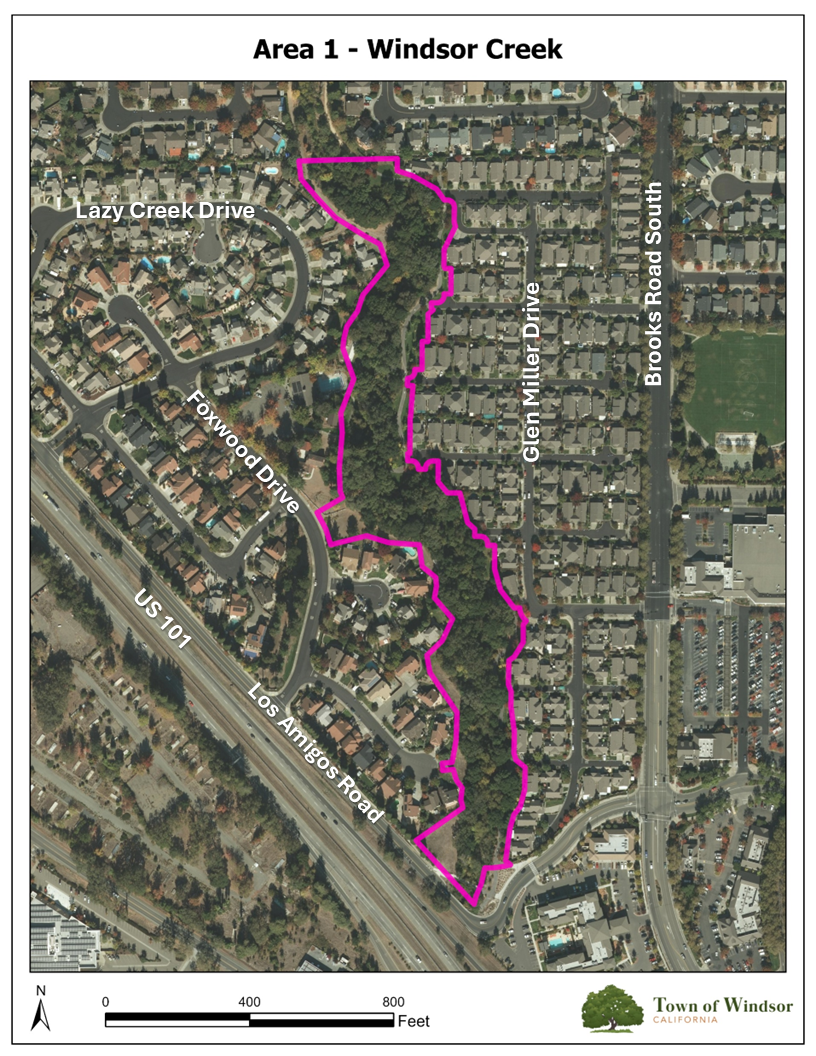
PROJECT TIMELINE - 2025
May 6 - 5pm, Public Meeting at the Windsor Senior Center. View the presentation here.
May 12 – Pre-bid meeting with Town staff and bidding contractors
May 29 – Contractor and Bird Survey bids are due
July – Town Council awards contracts
Sept/Oct – Biologist establishes boundaries for nesting birds, then vegetation removal begins
December 31 – Expect all work to be completed
FREQUENTLY ASKED QUESTIONS
- Will the project affect vegetation along established pathways that are maintained as park paths?
- The project will not remove any vegetation that is intentionally planted.
- Areas within the project scope that are not already maintained by Town of Windsor Parks Dept will have smaller vegetation removed to reduce ladder fuels.
- I’m concerned about the creek path in my neighborhood. What are the project’s restrictions for removing trees and other vegetation?
- No intentionally planted landscape trees or vegetation will be removed.
- If a tree is considered for removal, for trees 6 inches or larger, but less than 12 inches in diameter at chest-height (4.5 feet from ground level), the contractor must obtain a Town-issued permit before the tree is removed.
- No trees 12 inches in diameter or larger at chest height will be removed.
- If a 20-foot emergency access pathway already exists, no trees 6 inches in diameter or larger will be removed.
- To help prevent erosion, no trees or vegetation will be uprooted.
- No vegetation will be removed within 5 feet of the top of the creek bank, in the creek bed or in the creek channel. Working in these zones would require additional permits from other resource agencies and is beyond the scope of this project.
- What environmental protocol is this project following?
- Protecting Water Quality:
- No work conducted within 5 feet of the top of the creek bank.
- No use of herbicides.
- Minimal soil disturbance to reduce the risk of erosion into the creeks.
- Protecting Wildlife:
- During nesting season, each work zone will be surveyed and cleared by a biologist before work begins.
- Before the project was approved the U.S. Environmental Protection Agency conducted a complete assessment of the project. The results were published with the grant award letter from FEMA in the “Record of Environmental Concern”.
- Protecting Water Quality:
- Neither stream boundaries nor property lines are currently marked or otherwise discernible, except where the property line is at a fence. How are contractors expected to be able to determine how much tree and brush removal is required?
- In lieu of a property line survey, the fence lines will be used to establish the property lines.
- The project proposal calls for limbing of trees to 14 feet, for trees of 6" diameter or more. Some trees with that diameter are not particularly tall - less than 20 feet high, for example. Limbing of such a tree could kill it. Do contractors have discretion to do limbing of less than 14 feet when they believe that is required to prevent killing a tree?
- Trees will have limbs removed up to 14 feet vertically only if doing so does not threaten the life of the tree.
- A certified arborist is required to assess each work site to determine the appropriate level of limb removal that optimizes tree survival while meeting the requirements of the grant.
- Did the Town consider dividing the contractor work into parts, so that contractors could review, and bid on, just one or two parts of the project - for example, the work along East Windsor Creek?
- The nesting bird survey will not be started until June, at the earliest. But contractor bids are due by May 29. So contractors won’t be able to take into account the impacts of buffers that are imposed based on the nesting bird survey. Isn't this lack of certainty going to result in higher bids, or contractor unwillingness to bid at all?
- No. It’s very common to request a bird survey bid at the same time as a contractor bid, and for contractors to wait to start work until the bird surveys are completed. Contractors are bidding on the entire project as a lump sum. There has been a lot of interest from contractors regarding this project, so we do not anticipate a lack of bids.
- One of the five areas for fuel reduction is north and west of the intersection of 4th Street and Franklin Street, along the southeast side of East Windsor Creek. Is the area along the creek, where wildfire fuel reduction is planned, publicly accessible, and if so, how does the public access this?
- This is one of the most densely vegetated areas of the project. The Town does not currently have plans to create a paved pathway for public access. The project will create a path for emergency vehicle access, but this path is not designed for recreational use.
- The project proposal says "All trees and vegetation within [the twenty-foot-wide] pathway will be removed." Does that mean removal of all grass and ground cover, so that what is left is only BARE GROUND and trees with diameters over 6"?
- If an existing emergency access path exists, removing all vegetation 20 feet from the property line is not necessary. Instead, the existing pathway will be maintained (for example, grass will be mowed to a maximum height of 4”). In areas outside of the access pathway, underbrush, trees less than 6” in diameter, and tree limbs of larger trees (trunks 6” and larger in diameter) will be removed. Any intentionally planted trees and bushes will be retained. [BB2]
- Along East Windsor Creek, many of the back yard fences have vines growing on them. Assuming that the back yard fences are the on the property line, does that mean that contractors will remove the vines?
- Vines must be maintained free of dead or dying material, or they may be removed per Sonoma County Fire District regulations.
- The FEMA grant says that no work can be done within 20 feet of a "stream edge". The project proposal says that no work can be done with 5 feet of a "creek bank". These are NOT the same thing, unless tops of creek banks are uniformly exactly 20 feet from stream edges. Why does the project proposal use a different measure/distance than the FEMA grant?
- 5 feet from the top of the creek bank is the best measurable standard to ensure that each stream is protected from potential erosion, and in most cases, it meets the 20 ft requirement. In some cases where the stream edge is right below the top of the bank, the contractor must create a 20-ft buffer from the top of the bank. Town staff will make an assessment in the field where these constraints cannot easily be determined.
- Will a maximum stump height be specified in the contract?
- The maximum stump height will be 1” off the ground.
- What type of permits are necessary for tree removal?
- According to Windsor Municipal Code, a permit must be obtained from the Building and Planning Dept to remove the following species of trees, 6” in diameter or larger: black oak, blue oak, coast live oak, Oregon oak, Valley oak, Interior Live oak, Oracle oak, Chase oak, and California buckeye.
- Additionally, any tree whose species is not listed in the municipal code that 6” in diameter or larger, and that is considered for removal, must obtain written permission from the Town Engineer or Project Manager before it is removed.
- Was a CEQA analysis conducted? If this project is exempt from CEQA, how was the determination made?
- This project is categorically exempt from the CEQA process, under section 15304—Minor Alteration of Land.
- Parasite Mitigation Requirements-The Scope of Work (ref. pg. 76) states mitigation for the Mediterranean oak borer (MOB). How will the Town ensure the contractor can identify the MOB?
- A certified arborist is required to assess each work site before work begins. This includes assessing trees for the Mediterranean Oak Borer.
- Additionally, the contractor will be required to train their staff to identify MOB.
- Does this project target the removal of invasive plant species?
- This project aims to remove all underbrush, including invasive plant species, in the designated areas of the project. Because the grant requires minimal soil disturbance, no plants are allowed to be uprooted during this project. As required by the FEMA grant, this project is required to maintain vegetation removal for at least 3 years after project completion.
- If residents are concerned about invasive plants along riparian corridors, the Town encourages residents to volunteer with local organizations such as Russian Riverkeeper or coordinate their own effort with the Windsor Fire Department.
- Does the Town have plans to restore native vegetation along Town-owned creek corridors?
- Habitat restoration is not in the scope of this project. Residents who would like the Town to pursue a future project for habitat restoration along Town-owned riparian corridors are encouraged to bring it to the attention of their council members and to help allocate funding.